
In John Nichols History of the County of Leicestershire, is a copy of the return for charities in Leicestershire.
Nichols states that the return was as a result of an Act of Parliament passed in the 26th year of the reign of George III, 1786.
In 1837 commissioners were appointed by another Act of Parliament to make inquiries into the charities in England and Wales, their report being published in 1838.[1]
The lists from both sources for Thornton show 5 charities, these being Luke Jackson’s, James Harrington’s, William Grundy’s, Mr Wood’s and the Reverend Fox’s. Plus, a John Lea from nearby Bagworth.
The details for these are as follows:
Luke Jackson’s Charity
Luke Jackson was a Nottingham man, the son of Anker Jackson, a churchwarden of St Peter’s in Nottingham. Luke was apprenticed to a ‘girdler’ (a maker of girdles and belts), living in the parish of St Nicholas Acons in London. He eventually became a very rich man.
During his young life, two major events took place in our country’s history, the defeat of the Spanish Armada in July 1588 and the Gunpowder plot of 1605.
He died in 1630 and his will was proved in the Prerogative Court of Canterbury on 31 January 1631 by Richard Glidd and Richard Milles.
Luke Jackson owned land around Horsepool Grange, near to Stanton under Bardon, which extended towards Thornton, where it meets with Whittington Grange. (‘Granges’ were medieval estates). There is still a farm named ‘Horsepool Grange’, situated between Stanton and South Charnwood School.
Under the terms of his will this was placed in a Trust. The income from these lands was divided between St Peter’s Church in Nottingham and the Parish of Thornton; two thirds went to St Peter’s Church in Nottingham and one third to the Parish of Thornton, this last third was again divided into thirds, one third for each of the 3 villages in the Parish.
Out of the income for Thornton £2 per year was paid to the Vicar of Thornton to preach 2 sermons, one on 28 July commemorating the defeat of the Spanish Armada in 1588 and another on 5 November celebrating the failure of the Gunpowder Plot of 1605. By 1838 the Commissioners noted that the sermons were no longer preached.
In 1630 the total income to the Charity amounted to a sum of £20 per year, there were 5 trustees including George Jackson, the brother of Luke Jackson.
The will also stipulated that the land should be entrusted to “4 of the most honest and able persons dwelling in the Parish of Thornton and their heirs” by the last surviving trustee.
In 1799 the income for the Parish of Thornton amounted £13 13s 7½d, in 1812 to £15 15s. and by 1833 to £46 10s.
This charity is still paid to this day, annually to residents of the village of government retirement age and over.
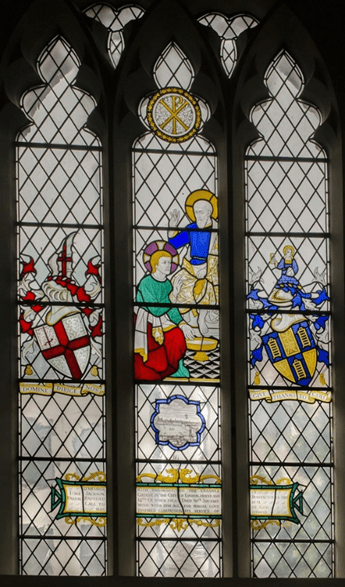
The Luke Jackson Window – St Peter’s church, Nottingham
This window lies to the east of the north door. The glass was inserted in the existing tracery in 1969. The window commemorates Luke Jackson a seventeenth century benefactor of St Peter’s.
The dedication in the glass reads:
Remember with thanksgiving the example of Luke Jackson, Girdler in the City of London, Friend and Benefactor of this Parish, baptised 14th October 1582, died 30th January 1631. Call to mind with him all for whom love of God has inspired compassionate service of others.
| The following paragraph is taken from the Book, Ancient Curious and Famous Wills by Virgil McClure Harris (1911). Charity Sermons to Celebrate National Mercies – Luke Jackson, citizen and girdler of London, by will dated 26th January 1630, reciting that he was seized in fee of certain tithes at or near Horsepool in the county of Leicester, being about £20 per annum, devised the same to certain persons on trust, yearly, to pay the clear rents and profits thereof in manner following: that is to say, two equal third parts as followeth, 40s thereof yearly to be given for two sermons to be preached in St Peter’s church in the town of Nottingham; on the 28th July and the 5th November, acknowledging God’s mercy and giving thanks for the deliverance of this land and people at two several times form the Invincible Armada, (as it was termed), in 1588, and form the Gunpowder Plot in 1605 : and the residue of the said two thirds to be distributed among the people in the parish of St Peter, at the discretion of his five feoffes, and the other third share of the clear profits of the said tithes as followeth, viz 40s, for two sermons to be preached in the church of St Thornton, near Horsepool, on the two above mentioned days; and the residue to be distributed among the poor people in the parish of Thornton, at the discretion of his feoffees (trustees). It was the vicar of those parishes to whom the money was first directed. It is not known when the obligation to deliver sermons ended. In 2018 another reference to the will was located. It states that Luke’s trustees were to entrust the distribution of the Charity monies in Thornton to ‘Four of the most honest and able persons dwelling in the said Parish of Thornton’. It is believed that the Luke Jackson charity absorbed another Thornton Charity – the Grundy Bread Charity – which gave bread to the poor. A ‘Bread Service’ was held annually and was still happening in the 1950’s. No questions were asked about poverty – whoever turned up was given a loaf of bread! |
William Grundy’s Charity
William Grundy was a resident of Thornton who died on 17 February 1718. By his will, dated 8 March 1717, Joshua Grundy left a cottage and garden in Thornton in trust with 2 trustees. Under the terms of his will the Vicar of Thornton was to preach a sermon on the day of his death every year for which he was to be paid 10s out of the rent from the cottage and garden.
Another 10s was to be spent on bread for the poor to be distributed after the sermon.
By 1838 the cottage and garden had been sold to a new owner and were let to 2 tenants, the new owner paid the Vicar 10s and the Churchwarden 10s direct.
James Harrington’s Charity
James Harrington was a resident of Thornton; he was buried on 25 November 1684. Under the terms of his will £26 was left for the benefit of the poor of Thornton. Out of the interest 10s was paid to the Vicar of Thornton to preach a sermon on 6 December every year. The remainder of the interest was to be used for the benefit of the poor. According to Nichols this amounted to 16s in 1786.
Mr Wood’s Charity
The 1786 Parliamentary Return notes that Mr Wood gave a sum of £2, the interest from this was to be used for the benefit of the poor of Thornton. In 1786 it was invested in Joshua Grundy, George Buckley and John Buckley and that 2s interest was being paid per annum.
Reverend Fox’s Charity
The Reverend Fox of Leicester left the sum of £10 in his will with instructions that the interest of this was to be used to buy bread for the poor of Thornton; this was to be distributed on 24 December of each year. In 1786 it was noted that this paid 10s and that the £10 was invested with Joshua Grundy, George Buckley and John Buckley.
According to the Report of the Parliamentary Commissioners £40 of this money was invested in the Hinckley to Melbourne Highway in 1770.
In 1838 this was producing 40s, 10s of this was being paid to the Vicar of Thornton for preaching his sermon on 6 December; 20s was paid out to Jackson’s Charity with the remaining 10s being used to buy bread for the poor for distribution on 24 December.
Robert Smith
On 2 June 1710 Robert Smith, a butcher of Thornton, signed a covenant leaving a property called Smith’s Wood Croft, situated in Thornton, for the benefit of the poor of the village. The property was valued at £8 13s 4d and had a tenant, John Lawes. The commissioners were named as John Rogers, James Winstanley, George Buswell and Elam Crawford.[2]
John Lea
Gave by will (1675) 4s. annually to be distributed amongst four of the poorest in Bagworth, 5s for preaching a sermon every Monday in Easter week; 5s. for the schoolmaster for teaching a poor child: and 6d. for bread and ale to be given away at the School House in Bagworth yearly, on Easter Monday.
A newspaper article (date and origin unknown) states ..
‘The united benefice of Thornton and Bagworth seems to have been more than usually well provided for by charities, in number if not in size, and the distribution of some of these, in kind, was preserved until a later period than has been the case with many similar charities elsewhere.
Researched by Pete & Jo Leadbetter, Trevor Roberts & Gill Tapping
[1] Report of the Commissioners appointed in pursuance of an Act of Parliament, 1838
[2] National archives, C93/50/19
 Thornton