
There is evidence of mining at Swannington, Leicestershire as far back as the 13th century. This was mostly in shallow pits. The start of the industrial revolution and early steam power meant mines could be deeper. The Leicestershire-Derbyshire coalfield is divided into two areas split by a major geological fault. Leicestershire is in the Eastern Basin. In the 1820s workable coal seams were found at Ibstock and Bagworth and this encouraged further shafts to be sunk in the area. Railways and steam were instrumental in mining expansion and lead to rapid coal delivery to major towns where demand for coal was great due to industrialisation.
The Lindridge Coal Company
1875 – the first mine shaft was sunk on the Lindridge estate by Harrington Offley Shore, who had lived at Lindridge Hall, Desford since 1870. Harrington Shore came from a Sheffield family of bankers. He thought he could make his fortune having calculated that coal could be found on his land owing to its geographical position on the eastern edge of the coal measures. Unfortunately, the site was where the coal measures strike the Thringstone Fault. The site became unworkable with insufficient coal and constant flooding. Pumping the pit dry was costly and in 1877 the company ran out of money and Lindridge Coal Co. closed. Harrington Shore was declared bankrupt.
1975 – the shaft was capped and finally filled in. Remains of a steam pump were found still in position.
The Desford Coal Company
1900 – The Desford Coal Company was registered. Ernest Bramall a mining and mechanical engineer, the son of Henry Bramall a colliery owner from Lancashire sank the first two mine shafts at a site southeast of the already established Bagworth Colliery. No. 1 shaft served the Lower Main seam and No 2 the Upper Main Seam.
A single track was laid from the Midland Railway’s Leicester-Burton line to the colliery and a signal box was opened. In September the still unfinished colliery took delivery of its first locomotive, the Countess of Warwick.
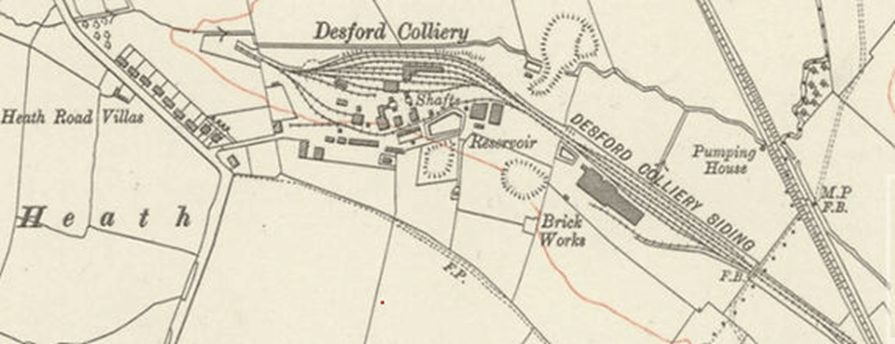
Reproduced under a Creative Commons Attribution-Non-Commercial-Share Alike 4.0 International (CC-BY-NC-SA) licence with the permission of the National Library of Scotland.
1902 – Coal extraction began from Upper and Lower Main Seams.
1908 – Delivery of a second locomotive, the Desford.
1912 – The first national miners’ strike for a minimum wage took place. 1000 Desford men walked out. The strike lasted for 6 weeks.
1926 – May 3rd – The General Strike began. It finished on 13th May. However, the pit was shut for 26 weeks and afterwards, only part time working took place until 1939.
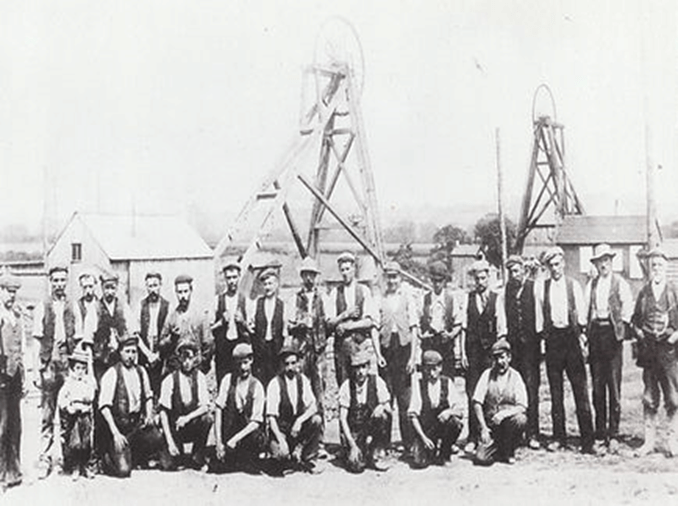
1927 – The Desford Brick Company was opened and later a railway siding connection was made with the colliery.
During the 1930s – rearrangement to the colliery surface layout took place with a ferro-concrete cooling tower replacing the old wooden one. The underground ventilation system was improved, and electricity installed enabling more mechanisation.
The Miners Welfare Hall was opened in a former Wesleyan Chapel, at the top of Lindridge Lane, Desford. This later became the Village Hall.
1939/40-45 – The outbreak of war and a need for increased coal production led to a return to full time working. Three new shafts were sunk. During this time up to 880 men were working underground. Coal faces were often given names Burma and Antwerp being two Desford ones. Miners could say they were working in Burma or Antwerp!
1942 – Bore holes to the south of Desford showed there were workable drifts. Two drifts were driven from the surface at Merrylees by Desford Coal Co. The first coal was brought out the following year.
January 1st, 1947 – Coal mines were nationalised.
The combined outputs of Desford and Merrylees were just over 600,000 tons, this increased over time.
1947 – The colliery took delivery of its fourth locomotive, the Desford No. 3.
1948 – An explosion at No1 pit was caused by naked light working. 14 men were injured. Safety lamps were used routinely from then on throughout Leicestershire pits, although they had been in use elsewhere for many years.
The Desford Chock
1950s – Matthew Smith, the undermanager at Desford Colliery, invented ‘the Desford Chock’, the first ever hydraulic powered roof support. Sam McKee, the mine agent developed it further. Three prototypes were tried using the fire hydrant to supply the water pressure. The inner and outer cylinders were made at Tubes. (The company formerly occupied a site at Newtown Unthank.) The ‘Chock’ replaced the wooden ones and contributed much to mine safety.
Over the next 10 years improvements to the miner’s welfare were made. Pit Head baths and a medical centre were built.
1963 – The last pit pony left Desford.
1966 – Underground connection was established with Merrylees Drift Mine, and Merrylees coal was conveyed to Desford. Later, Merrylees reserves were exhausted. Desford achieved a record weekly tonnage.
1972 – Miners struck for better pay. The strike lasted for 7 weeks and led to a 3 -day working week to save electricity.
1974 – Miners again struck for better pay.
1982 – Lower Main Seam ceased production after 80 years.
1983 – Upper Main Seam ceased production, the first and last to be worked.
February 10th, 1984 – Desford Colliery closed, just weeks before a year-long miners’ strike. The coal was now of very poor quality and there were flooding problems.
The pit had produced some 30 million tons of coal over its working life.
During its working life a significant number of men were killed or injured at Desford Colliery

Information courtesy of Desford & District Heritage Society https://www.desfordheritage.org
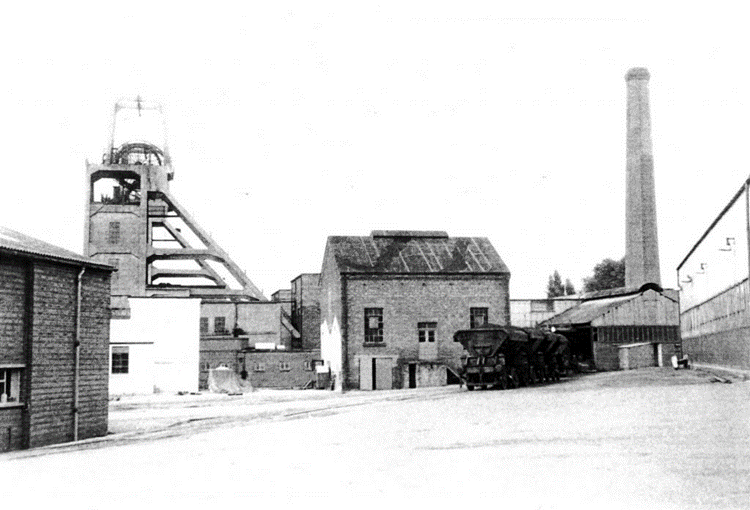
https://www.nmrs.org.uk/mines-map/coal-mining-in-the-british-isles/leicestershire/desford-colliery/
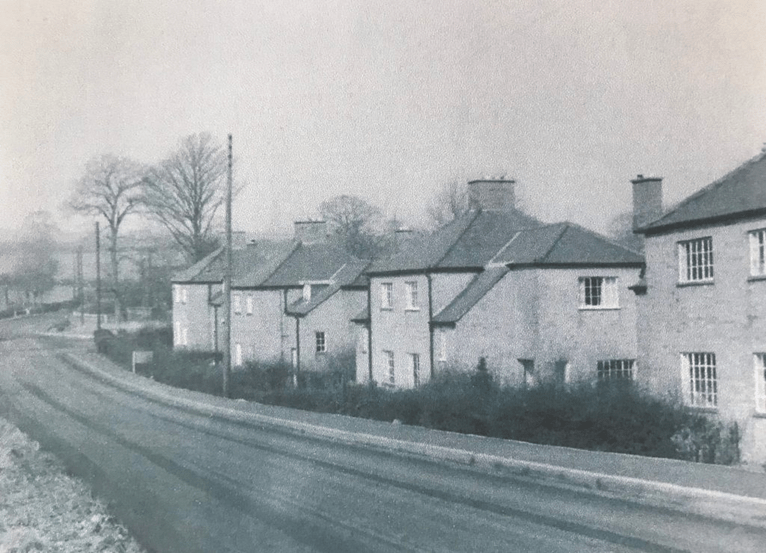
The colliery had a sports ground and pavilion and its own housing at Desford Colliery Village, where Thornton resident, Colin Harris used to live (demolished in the 1980s).
 Thornton