
Frances (‘Daisy’) Evelyn Maynard was born on 10th December 1861 at Easton Lodge, Great Dunmow, Essex, the daughter of the Honourable Colonel Charles Maynard and his wife the Honourable Blanche Fitzroy.

Frances’ father was an extremely wealthy man, owning large tracts of land including Bagworth and Thornton.
Her mother was doubly descended from Charles II through two of his most notorious (and beautiful) mistresses, Nell Gwyn and Lady Barbara Villiers.
Her father died in 1865 and Frances (or ‘Daisy’ as she was known in the family) and her younger sister ‘Blanchie’ inherited his estates.
In 1867 her mother remarried, to a senior courtier, Lord Rosslyn, a favourite of Queen Victoria.
As a result of the marriage, Daisy gained three half-sisters who in time became the Duchess of Sutherland, the Countess of Westmoreland and The Lady Angela Forbes.
Daisy was beautiful as well as wealthy and well-connected: quite something on the marriage market. Indeed, Queen Victoria’s youngest son, Leopold, Duke of Albany, wanted to marry her, a wish that Victoria strongly supported.
Daisy however was already in love with someone else and in 1881 Daisy married Francis Greville, Lord Brooke: ironically Prince Leopold’s equerry. The wedding was the social event of the year of royal proportions.
Daisy was soon a great society hostess whose parties were legendary. She loved luxury and her motto seems to have been “spend, spend, spend”.
By 1885 the Brookes had three children, including the required son and heir (born 1882 and christened Leopold); Daisy felt free to throw off the shackles of Victorian matrimony to join the “Marlborough House Set”, an infamous upper-class ‘social club’!
Queen Victoria’s final, damning comment on Daisy was “she is fast, very fast”.
Daisy soon began affairs with a number of influential men including politicians, fellow aristocrats and the future Edward VII.
She is reputed to be the inspiration for the music hall song, “Daisy, Daisy give me your answer do”.
In 1893 Lord Brooke became the 5th Earl of Warwick and ‘Countess Daisy’s’ new home was Warwick Castle.
While she was a mistress of Prince Edward, Daisy was also having a clandestine affair with his close friend Lord Charles Beresford. When Edward found out, he was not pleased and ended his acquaintance with her for a time, taking up with Mrs Keppel.
Daisy’s problems really began at this point when she was supplanted in the royal favour: she was not the sort of woman to be quiet about things, and she was known for telling everyone her secrets, her nickname in high society being “the Babbling Brooke”.
Lady Beresford had somehow managed to get hold of a letter that Daisy had written to her husband Lord Beresford, in which Daisy berated him for deciding to stay with his wife! Prince Edward was furious and demanded to have the letter. It took the intervention of the Prime Minister, Lord Salisbury to resolve the dispute. Yet despite this, Prince (later King) Edward, could not resist her charms for long, and they remained at least friends for the rest of his life.
Daisy went on to have two more children – a boy (Maynard) in 1898 and a girl, Blanche, in 1903. These last 2 children were not fathered by her husband but by Joe Laycock, a Boer War Army Officer who had become a multi-millionaire through inheritance. Together they became the darlings of the hunting, shooting and fishing set. But, a known womaniser, Joe abandoned Daisy in 1903 for her best friend, which left her distraught and keen to find a new path. The next 35 years of her life were to be completely different.
‘Our Daisy’ – the Countess of Warwick – Part 2
In the second half of her incredible life, Daisy was to prove she had a social conscience. An early socialist, Robert Blatchford, wrote a scathing article about her in a left-wing paper called ‘The Clarion’ which annoyed her so much she decided to discuss it with him face to face.
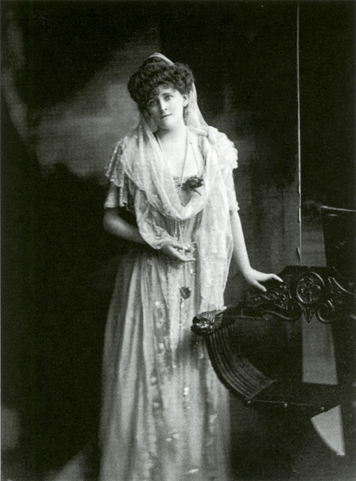
This attack followed a particularly extravagant social event at Warwick Castle called Le Bal Poudré. What was actually said, we do not know, but as a result Daisy joined the Social Democratic Federation in 1904.
She gave the organisation large amounts of money and supported their campaign for free school meals for children. She founded a girls’ needlework school at Easton in Essex and Studley Agricultural College for Women.
Daisy’s houseguests at this time included George Bernard Shaw, Gustav Holst, Ramsay McDonald and HG Wells, during this period she started to write seriously.
Thanks to the fact that Daisy owned several parishes, she used her influence to appoint only left-wing clergymen.
A declared pacifist, she opposed Britain’s participation in the 1st World War, but supported the Russian revolutionaries in the October revolution.
After the end of the Great War, she joined the Labour Party and became fascinated by the developing Trades Union movement, promoting the cause of coalminers and railwaymen, touring the Midlands in her smart red Wolsey car.
But Daisy was soft-hearted and sentimental and became too generous. With her commitments to good causes, by the end of the First World War her money had started to run out. She had to sell off many of her properties, the manor of Bagworth and Thornton in 1919 being one example. At one point it is alleged that she tried to blackmail King George V by threatening to publish love letters written to her by his father Edward VII.
The Government lawyer apparently stopped her dead in her tracks by pointing out that since Edward had written them, then the copyright belongs to King George V and so she had no right to publish.
As she got older, Daisy became more left-wing; she stood as a Labour candidate for Warwick and Leamington in the general election of 1923 but came third.
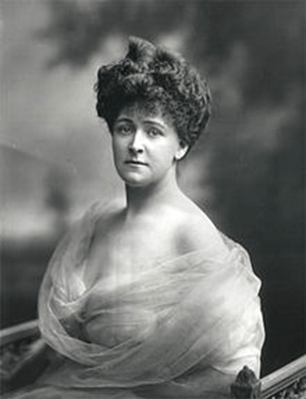
Countess of Warwick, Lafayette Studio 1899
Daisy’s commitment to her causes was such that in 1923 and again in 1926 she tried to give away her country house in Essex – Easton Lodge – first to the Labour Party and then the Trade Union Congress (TUC). They both turned it down because she was a Countess and therefore a symbol of privilege (although they had accepted her previous financial donations).
No-one seemed to appreciate all the good she had tried to do.
She became very disillusioned with Socialism and from then on stayed at home at Easton Lodge, concerning herself primarily with animal welfare, her private zoo and gardening.
Daisy died on 26th July 1938 aged 76.
A fitting epitaph would be her own words: ‘I was a beauty, and only those who were alive then know the magic that that word held for the period. I was physically fit, unspoilt, and I adored dancing.’
Researched by Pete & Jo Leadbetter
 Thornton