
Thornton Reservoir
Thornton Reservoir is a quiet and peaceful place to really appreciate nature. Owned by Severn Trent Water it ceased to supply water to Leicester directly from 1982, but in 1997 it opened to the public as a recreational resource.
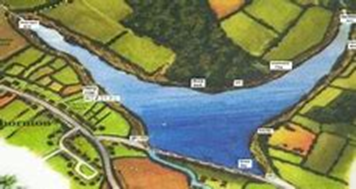
The reservoir has a mixture of habitats and a woodland on the north shore. Sadly, the onsite trout fishery closed down in early 2024.
The water is home to a variety of water birds, including cormorants, mallards, swan, egrets, mandarin, great crested grebe, tufted ducks, heron and regular visitors from abroad.
There is a well surfaced 2.5-mile circular track around the reservoir which has a level access and is great for walkers, cyclists and wheelchair users. Other paths then take you into the woodland area and look out for the sculpture trail around the site for fascinating sculptures which reflect the reservoir’s bird life.
Sustrans national cycle route 63 runs around the reservoir and village.
On the northern side of the reservoir there is the option of extending your walk into the adjacent Browns Wood. The Leicestershire Round (a circular walk around Leicestershire of 104 miles) also runs past the reservoir together with the National Forest Way (a 75-mile walk extending from the National Memorial Arboretum in Staffordshire to Beacon Hill Country Park in Leicestershire)
The National Forest Way path was opened in May 2014.
If you take the National Forest Way/Leicestershire Round from the reservoir past the school, then down Hawthorne Drive it leads past Thornton Mill over (or under) the railway line into Bagworth Heath.
Bagworth Heath Country Park
Desford Colliery closed on February 10th, 1984, but it was another 7 years (1991) before work began to reclaim the derelict colliery site. The 185-acre site was transformed into Bagworth Heath Country Park, with a fishing lake, walks and cycle paths. Leicestershire County Council own and manage the park.
Another walk, 11 miles long ‘Coal tips to country parks’ starts at Bagworth Heath
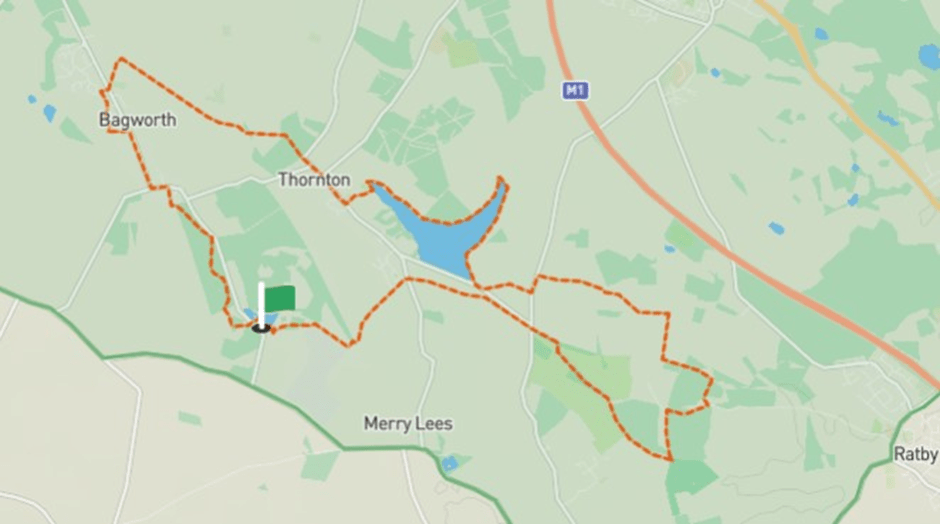
Coal Tips to Country Parks 11-mile walk
This 11-mile walk takes you on a route which passes through former coal mining sites which have now been transformed into woodlands and country parks, and by the picturesque Thornton reservoir.
The exploitation of deposits of coal – the famous ‘black gold’ – has been central to the region’s economy for centuries. Not only have the coalfields of Derbyshire and Leicestershire played a significant role in the history of British mining, but the industry that developed around them has shaped both the local landscape and the heritage of the people who live and work there.
The landscape, once scarred with primary extraction of minerals, is now reclaimed for people and nature. This route gives a real sense of this transformational change, as you walk through ancient woodlands and historic sites which survived the ravages of industry, and onto new woodlands planted on new ground, linking the old and the new of the developing Forest.
Centenary and Royal Tigers Wood
This 33-hectare woodland site is made up of two sections. Centenary Wood to the north was planted to commemorate 100 years of Bagworth Parish Council, while the southern wood was named in commemoration of the Royal Leicestershire Regiment.
The wood was purchased by the Woodland Trust in 1993, with financial support from the Royal Leicestershire Regiment, and occupies a prominent hillside position south of the village of Bagworth. The site, formerly used for arable crops, features mature trees, hedgerows, a stream and open grassland.
The surrounding countryside has a history of mining and the nearby Desford Colliery, which has now been largely restored, can be seen to the east. Centenary and Royal Tigers Wood has been designed to complement this restoration work, forming an extensive area of community woodland. The grassland areas have been retained and are mown for hay to encourage a rich mixture of wild grasses and flowers.

The Royal Leicestershire Regiment’s history as a fighting unit goes back as far as 1688 when the Regiment fought the French in Flanders. In recognition of the Royal Leicestershire Regiment, a memorial stone and an arboretum have been incorporated into the woodland. Trees planted in recent decades include oak, ash and field maple.
National Forest
In the late 80s, large swathes of the Midlands landscape had been scarred by centuries of coal mining and clay extraction. For more than 30 years a quiet revolution has been taking place in these 200 square miles of the Midlands which includes Thornton. More than 9.5 million trees have been planted in what was once one of the least wooded parts of the country, steadily expanding and connecting woodland across a previously fragmented landscape.
From black to green
Following the closure of the coal mining and clay extraction industries in 1980s, large swathes of the Midlands landscape had been left scarred and derelict, with a loss of community identity and an uncertain future. But a passionate group of people had a vision; the first broadleaf forest to be created at scale in England for over 900 years. A place where woodlands would be at the heart of a revitalised landscape, with trees growing alongside where people lived and worked.
A story of regeneration
In the late 1980s the government launched a competitive process to identify the location for a new multi-purpose forest. With a groundswell of public support, a landscape in need of change and an ambition to connect the ancient remnant forests of Charnwood and Needwood, the National Forest area was chosen. By 1991, the 200 square mile boundary was agreed, and the first trees were planted.
A place of transformation
From these early beginnings, the idea has been nurtured and grown, supported by partners and successive governments for over three decades. Today, the mines have been restored, the landscape transformed, and Forest cover dramatically increased from only 6% of the land area to more than 23%. It is a success story of environmentally led regeneration, restoring nature, improving the wellbeing of communities and stimulating the green economy.
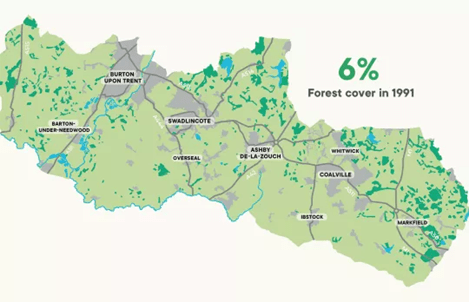
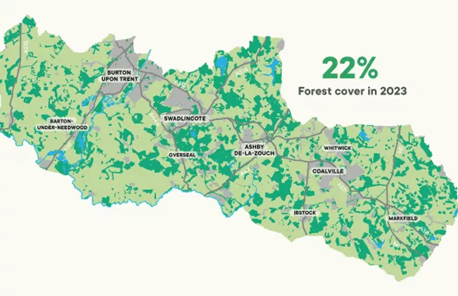
https://www.nationalforest.org/
https://www.woodlandtrust.org.uk/
Burroughs Wood/Pear Tree Wood and Martinshaw Wood
To the south and east of Thornton, between Thornton, Groby and Ratby are three other areas of outstanding beauty owned by the Woodland Trust: Burroughs Wood, Pear Tree Wood and Martinshaw Wood.
Beautiful woods to visit all year-round, but most notably in the spring when the forest floor is a carpet of bluebells. Burroughs wood is divided in two by a public right of way, the northern section containing an ancient woodland, while to the south is a newly planted wood, created in the late 1990s. There are paths throughout the 36-hectare broadleaved woodland and grassland site, providing good access to gentle and undulating slopes.
Pear Tree Wood was created in 1997 to connect nearby Burroughs Wood and Martinshaw Wood. Although planted with essentially a mix of native broadleaved trees, conifers in the northern section blend with those at Martinshaw Wood, to encourage the movement of pine-loving wildlife, particularly moths. The wood also includes a millennium feature of 12 coast redwoods, as well as a number of Scots pine. Open ground has been left at the stream to encourage different species to thrive in different habitats.
Set across 103 hectares, Martinshaw Wood is a vast and picturesque woodland, steeped in history. This ancient woodland site was cut in two when the M1 motorway was built in 1969 and passing motorists may be unaware of the beauty on either side of the carriageways, with the two parts now connected by a bridge crossing the motorway.
Martinshaw Wood is rich in ecological and archaeological interest. Considered to have been listed in the Domesday Book and thought to have an Iron Age enclosure at the north end of the woods, the site contains a rich array of 36 tree species, including Scots and Corsican pine, western red cedar, Lawson’s cypress and aspen. A progressive felling of conifers to favour oak, beech, birch and other broadleaves will restore some of the wood’s origin as a deer park.
Flooded quarry pits are home to a variety of wildlife such as newts and a wide range of birdlife frequent to the woodland. Sightings include woodcock, mistle thrush and the great spotted woodpecker. Fungi are prominent throughout Martinshaw Wood, from stinkhorn to candlesnuff fungus. Martinshaw Wood is the perfect place to see a host of rare and interesting insects. Bees, butterflies, hoverflies and damselflies are abundant during the summer months, and beetles can be seen throughout the year. This Woodland Trust wood is also home to 270 species of moth, many of which are rare.
 Thornton