
The fourteenth and fifteenth centuries were a strange time, with almost continuous warfare both abroad and at home, plague, riots and famine, but there was also unimaginable luxury for the wealthy, living in their moated castles and manor houses, surrounded by ancient parks, each with its own hunting lodge.
During those same years, there was a magnificent royal park near us, with a luxuriously appointed hunting lodge (perhaps a palace?) called The Bird’s Nest.
The building itself, first mentioned in 1362, disappeared long ago, and the moat was filled in in the 1940’s, but the ghostly footprint that remains is still one of the key listed building sites in the Leicester area. It is now just a large rectangle of grass, surrounded by earthworks in Glenfield, half way between Dominion Road and the A50.
The Bird’s Nest was the centre of ‘Leicester Frith Deer-park’, itself located within Leicester Forest (or ‘Hereswode’ in the Domesday Book). The Forest would have been a mixture of woodland and open grassland for royalty to hunt, ride and play in, far away from the prying eyes of London.
Leicester Forest extended eastwards from Bagworth, where Rothley Brook rises (previously known as ‘Heath Brook’), and would have included Thornton, Desford, Peckleton, Botcheston, Ratby and Kirby Muxloe, ending just west of the city of Leicester at the River Soar. To the north it would probably have reached as far as Anstey.
It was about 65 square miles of prime land; so, the Forest would have provided plenty of idyllic countryside for hunting, hawking, games and picnics.
It was also the perfect retreat for members of the royal family staying at Leicester Castle, which was then an impressive ‘town within a town’ – its stables said to hold 1,000 horses.
The Bird’s Nest was the favourite royal hunting lodge of the hugely powerful Plantagenet prince John of Gaunt, Duke of Lancaster, Earl of Leicester, Derby and Richmond, (addressed as ‘Monseigneur’), a son of King Edward III and the father of Henry IV.
John visited Leicestershire regularly, often staying at his beloved Leicester Castle from July to September.
Thanks to his marrying a very well-chosen bride, his estates became so extensive (worth about £43 billion in today’s money) they were referred to as the “Lancastrian Countries”.
John often brought his favourite mistress – Katherine Swynford – here, and he shocked our ancestors by holding her horse’s bridle in public! There is also a record of them in 1377 halting on their journey from Bosworth to Leicester Castle “by the village of Rathby, to join in merry sports and dancing” – with the villagers celebrating Meadow Mowing Day!
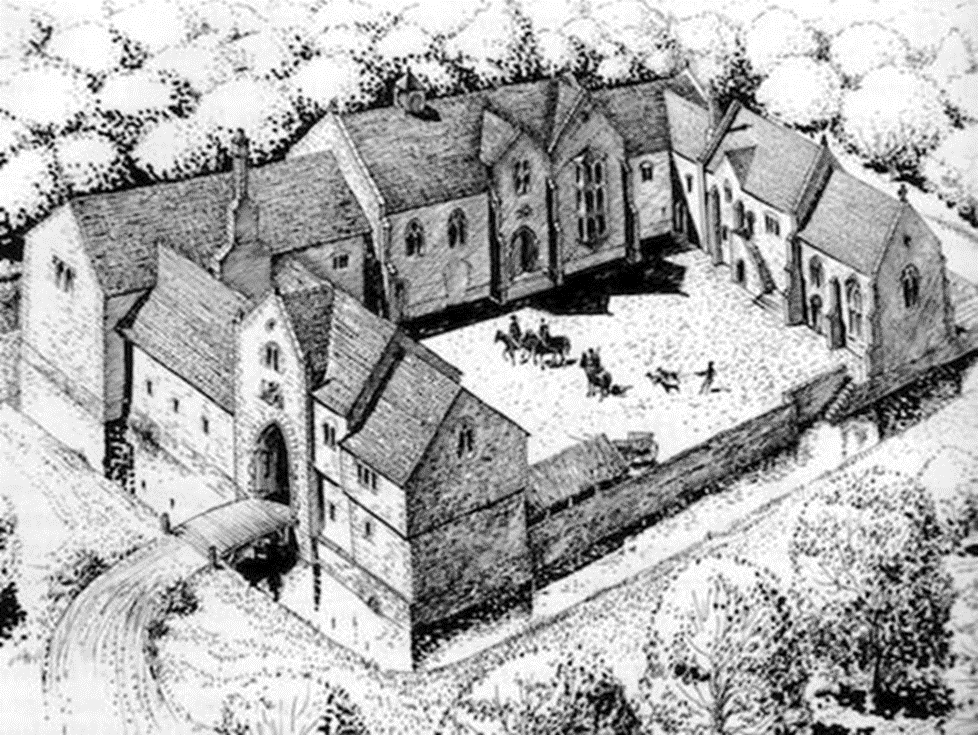
There is no reason why John of Gaunt should not have stopped off at Bagworth Park for refreshments. Our Lords of the Manor were from a branch of the Holland family; two ‘Hollands’ had married into the royal family. John of Gaunt’s second daughter, Elizabeth of Lancaster, married Sir John Holland in 1386 (after falling in love at court).
The Bird’s Nest was still in good repair throughout the Tudor period – in 1560 it still boasted a great hall and seven chimneys.
In 1628, Leicester Forest was sold off by King Charles I to raise money for a naval expedition in support of the French Huguenots. It was disposed of in lots for enclosures to be created.
The villagers of the Forest rioted but they had no chance of success against the king. More than 100 families were thrown off the land, losing their cottages and livelihood without compensation. Even the Earl of Huntingdon, a royal relative and Warden of Leicester Forest, had no say in the matter and received no compensation.
Researched by Pete & Jo Leadbetter
Biography: ‘Katherine Swynford’ by Alison Weir, Published by Vintage 2008 (Random House Group)
 Thornton