
The Leicester and Swannington Railway was officially opened on the 17th of July 1832 to transport coal from the pits in West Leicestershire to Leicester. The original stop was Desford Lane but renamed by April 1833 to Desford.
Robert Stephenson was the engineer, assisted by Thomas Miles, while his father George raised much of the capital for the building of the Leicester and Swannington Railway. When the first part of the line was opened in 1832 the train was pulled by “Comet” driven by George Stephenson. The train left West Bridge at 10am reaching Bagworth at 11am and consisted of an open wagon specially covered in for the use of the Directors together with 10 new coal wagons, with improvised seating, conveying about 400 passengers.
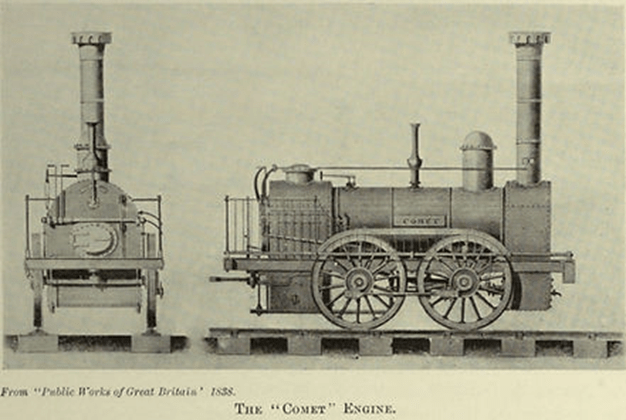
On that day there was a slight delay after Comet’s chimney struck the roof of the Glenfield tunnel. This was caused because platelayers had temporarily raised the track to pack a “low” place. The chimney was later reduced in height by 6 inches. It is said that the train stopped so the passengers could wash off the soot in the nearby Rothley Brook.
From 1832 until 1871, Thornton was served partly by Merry Lees railway station, and the Stag and Castle Inn built in 1832, which served as a station in Thornton Hollow, allowing Thornton residents to alight there instead of travelling into Bagworth until 1865.
On 4 May 1833 an accident occurred at Thornton Lane level crossing (now a bridge). The gates had been left open and a train ran into a horse and cart, the driver of which had not heard the engine driver’s bugle.
The Company had to pay for a new horse and cart along with fifty pounds of butter and eighty dozen eggs.
As a result of this accident George Stephenson, devised the steam whistle.
It was constructed by a musical instrument maker in King Street, Leicester and it became standard equipment on most steam trains thereafter.
Passenger Token
There were no platforms at the original stations. Passengers had to enter the carriages from ground level, using steps and handrail provided on each vehicle. This continued until 1876 when the Midland Railway erected platforms.
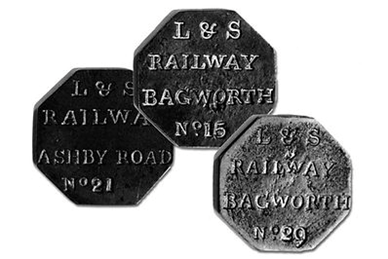
A train at that time usually consisted of 24 wagons of 32 cwt each. The demand came for passengers to travel by rail and a carriage was hastily built. Very soon about 60 passengers a day were using the line. Each passenger received a metal token marked with their destination which was handed in to the guard and reused.
The Leicester and Swannington Railway was the first railway in the Midlands and the third railway in the country. It was opened 5 years before Birmingham possessed a railway at all and 6 years before Birmingham was rail-connected to London.
Today
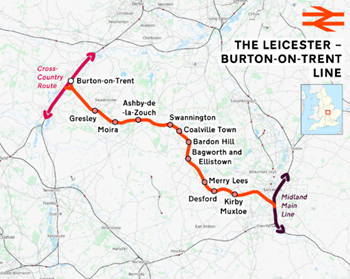
Despite repeated calls for the line, known as the Leicester to Burton Ivanhoe Line, to reopen for passengers it still remains for freight use only.
There are two quarries on the line – Stud farm (Cliffe Hill) quarry that sends out about 16 trains a week, and Bardon Hill quarry that sends out about 10 trains a week, but this can vary depending upon requirements. Most trains run loaded with stone between 2245hrs and 0400hrs with trains heading to Westbury, locations in London and Tinsley near Sheffield. Empty trains return to the quarries between 1400hrs and 2200hrs. Midweek is the busiest time for the railway.
 Thornton