
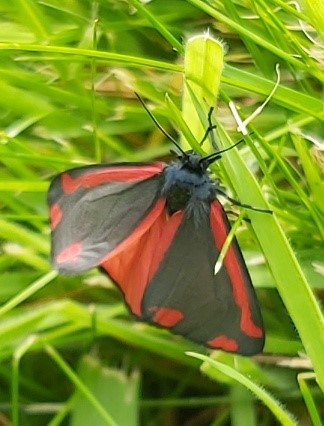
That’s right, many species of moths fly in the day, often in bright sunlight just as butterflies do. Probably the most familiar day flying moth to people is the Cinnabar. This smallish black and red moth is often seen in gardens. It lays its eggs on Ragwort plants and the “very hungry” black and yellow striped caterpillars do a fine job of keeping it in check. You can spot the plants later in the summer that have the caterpillars on, because they can be completely defoliated!
A fairly recent arrival to Leicestershire is the striking Scarlet Tiger moth and you have a good chance of seeing this beautiful moth flying in late afternoon and early evening sunshine, particularly in June. I have a thriving colony in my garden, but I am getting ahead of myself.
The story begins on a pleasant June evening in 2019 having a beer in the garden with a friend when a brightly coloured (we assumed butterfly) flew swiftly over our heads, that we couldn’t recognise. You could certainly be forgiven for thinking it must be a butterfly such as a Red Admiral, if you aren’t aware that it exists in our area.
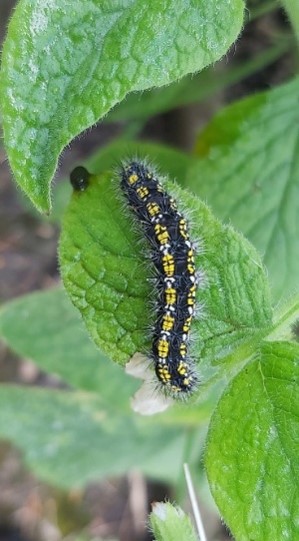
But the next year I noted hairy, black and yellow caterpillars, feeding on the Comfrey plants in my garden in the spring. With the help of an online app I identified these as Scarlet Tiger caterpillars, and the penny dropped as to what we had seen the year before, which was probably an egg laden female searching for new areas.
My moth books (which are 25 years old) state that this species is found only in the south west of England, but I knew a few others had been seen in south Leicestershire recently.
In June 2020 we were treated to the first adults, some of which even adorned us as jewellery whist sitting in the garden………………………..

Since then, they have bred every year with numbers building incrementally until 2025, when they dropped a little; it will be interesting to see what 2026 brings?
If anyone notices adult or caterpillars of Scarlet Tiger this year, I’d be interested to know your address, the date and a rough count of numbers seen, so I can chart the spread of this species locally. Email me on wrig361@gmail.com
Other day flying moths are, I must admit harder to see. But this year I had the joy of seeing my first adult Emperor moth (and not one, but two!).
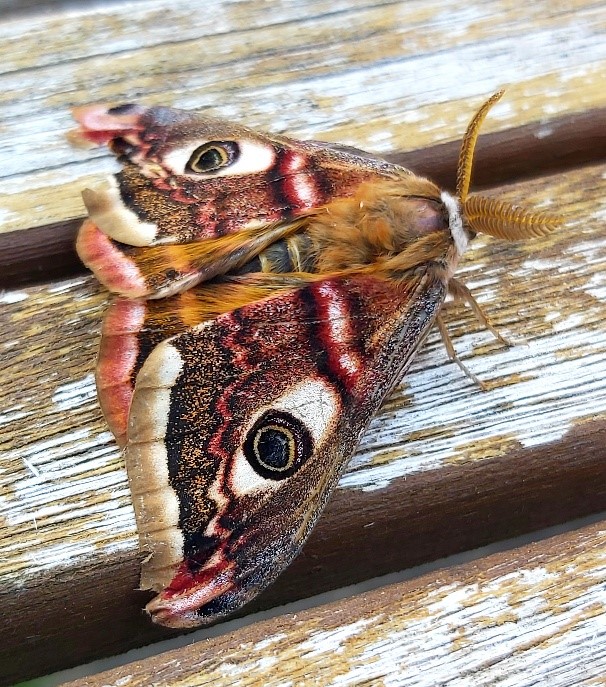
Despite being quite widespread across the country, the adults are rarely seen. The females fly very little, but give off a strong scent that attracts males from some distance away. It is these searching males that occasionally get seen. The development of synthetic pheromone lures in the last few years, has meant seeing these has become more possible.
On the 8th of April, after an unsuccessful search for them in the Soar valley on a unseasonable hot day, I returned home and decided to hang the lure on my washing line, whilst I had a much needed cup of tea.
And yo, within 10 minutes this male had approached and ultimately landed on the lure!
This was repeated again on the 25th April, with a different male appearing in my garden. After that I haven’t used the lure again, not wanting to disturb any males again in my vicinity this year.
Article by Thornton Resident – Dave Wright May 2026

